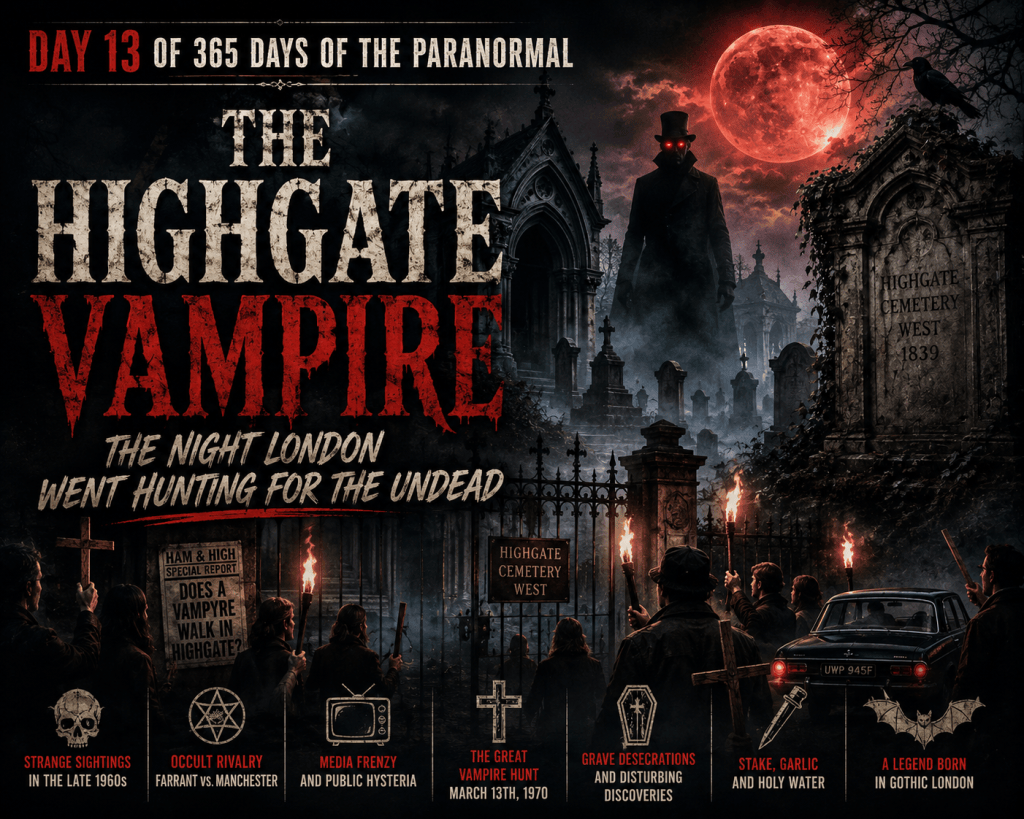
The Highgate Vampire
The Night London Went Hunting for the Undead
Hello there!
If you thought the weirdness at Bempton Cliffs was wild, the story of the Highgate Vampire is on a whole other level.
This isn’t simply a spooky ghost story. It is one of the most bizarre episodes in modern British paranormal history—a strange collision of Gothic Victorian decay, alleged supernatural encounters, the rise of modern occultism, media-fuelled hysteria and a spectacularly bitter feud between two rival paranormal investigators.
At the centre of it all was a mysterious, dark figure said to stalk one of London’s most atmospheric cemeteries.
Some called it a ghost.
Others claimed it was something far more terrifying.
A vampire.
So grab a coffee, because we’re taking a deep dive into the extraordinary madness of the Highgate Vampire.
THE SETTING: HIGHGATE CEMETERY IN THE LATE 1960s
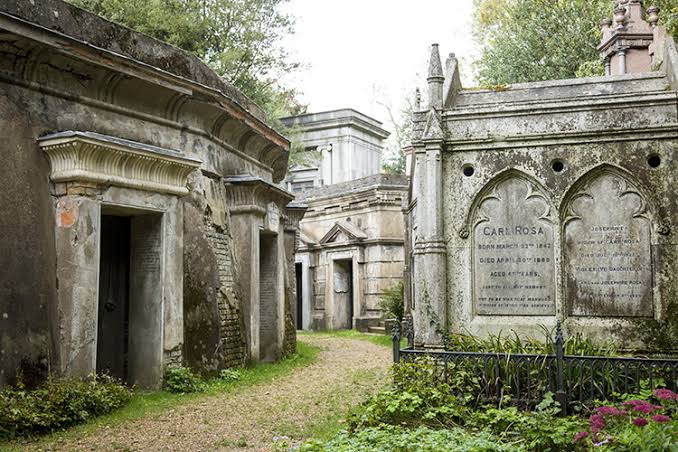
To understand how the legend began, you first have to imagine Highgate Cemetery as it was during the late 1960s.
Today, it is one of Britain’s most famous historic cemeteries, beautifully preserved and carefully managed. Among those buried there are Karl Marx, George Eliot, Michael Faraday and many other notable figures.
But in the late 1960s, particularly in the western section, Highgate was a very different place.
The great Victorian cemetery had fallen into severe neglect.
Trees and ivy consumed elaborate Gothic tombs. Stone angels disappeared beneath vegetation. Tree roots cracked open graves. Catacombs lay hidden within an overgrown wilderness, while vandalism and grave desecration became increasingly serious problems.
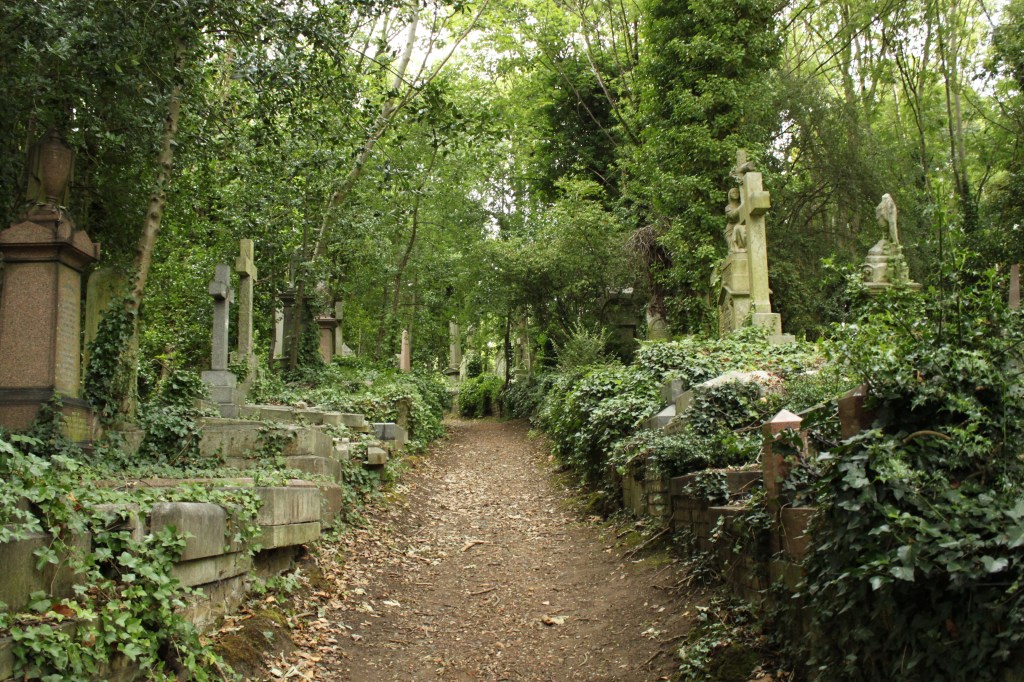
It was intensely atmospheric.
Incredibly spooky.
And the perfect stage upon which to create a modern vampire legend.
THE SIGHTINGS BEGIN
By the late 1960s, strange stories were circulating about Highgate Cemetery and the surrounding area, particularly along Swain’s Lane, the steep and narrow road running between the eastern and western sections of the cemetery.
People began reporting bizarre encounters.
One elderly woman walking her dog allegedly encountered a tall, dark figure that appeared to glide across the road. The apparition reportedly had piercing eyes and radiated an unnatural, icy cold.
Another account concerned an accountant who became lost inside the cemetery. After hearing what sounded like a tolling bell, he supposedly turned to see a tall, dark shadow staring directly at him.
He claimed he was completely paralysed.
Unable to move.
Unable to look away.
It was as though the entity had somehow hypnotised him.
And then, suddenly, it vanished.
Other strange reports followed.
A spectral cyclist.
A mysterious woman dressed in white.
Strange glowing mists rising among the graves.
But one particular description began to dominate the growing legend:
A tall, dark figure with piercing eyes, silently stalking the cemetery.
And soon, two men would transform this local ghost story into a national sensation.
ENTER THE RIVALS: FARRANT VERSUS MANCHESTER
No account of the Highgate Vampire can be told without mentioning two extraordinary and controversial characters:
David Farrant and Seán Manchester.
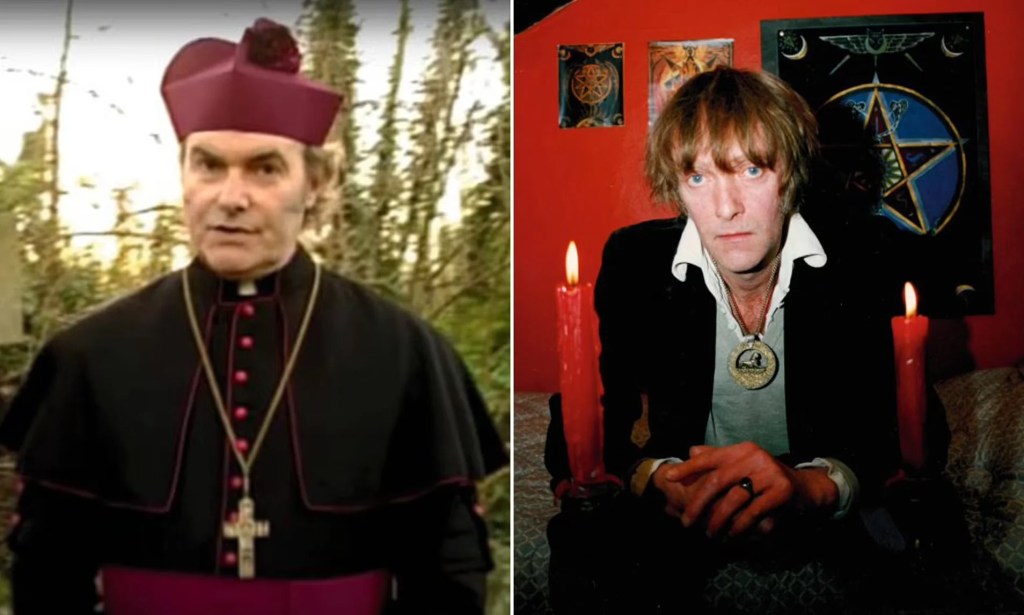
Manchester on the Left and Farrant on the Right
Their interpretations of the Highgate phenomenon were very different.
Their dislike of one another would become legendary.
And their bitter feud would continue for almost half a century.
DAVID FARRANT: THE OCCULTIST
In February 1970, local occultist David Farrant wrote to the Hampstead and Highgate Express following earlier reports of strange activity around the cemetery.
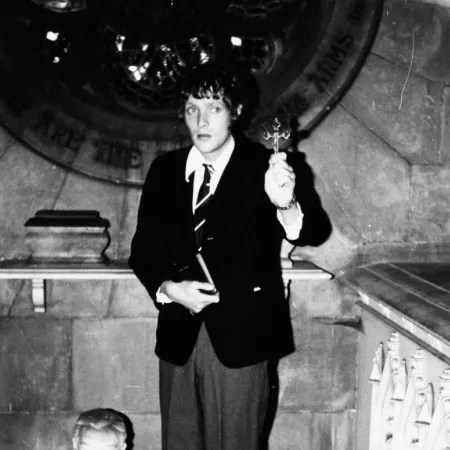
David Farrant
Farrant claimed that on Christmas Eve 1969, he had seen a mysterious grey figure within the cemetery grounds.
He didn’t initially claim it was a vampire.
Instead, Farrant believed the apparition might be a ghost or some form of supernatural entity—perhaps the spiritual projection of an earthbound soul.
The letter attracted attention.
And then another man entered the story.
SEÁN MANCHESTER: THE VAMPIRE HUNTER
Seán Manchester was a flamboyant occult investigator who would later describe himself as a bishop, exorcist and vampire hunter. However, he was not a bishop or at least within any globally recognised Christian denomination. Nor could any confirmation be made about the official title of exorcist.
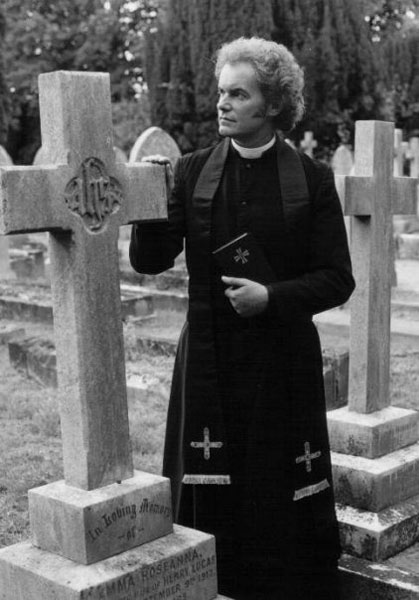
Sean Manchester
And Manchester raised the stakes considerably.
In an interview with the Hampstead and Highgate Express, published beneath the unforgettable headline:
DOES A VAMPYRE WALK IN HIGHGATE?
Manchester declared that the entity haunting the cemetery wasn’t merely a ghost.
It was a King Vampire of the Undead (nothing like overegging the pudding is there).
According to Manchester’s extraordinary account, the vampire was supposedly a medieval Romanian aristocrat and black magician whose body had been brought to England in a coffin during the eighteenth century by followers of his cult.
The body was then allegedly buried on land that would eventually become part of Highgate Cemetery.
Manchester also claimed that young women were being telepathically enslaved by the creature, allegedly developing mysterious puncture marks on their necks and symptoms resembling anaemia.
There was, however, one rather substantial problem.
Independent evidence supporting this extraordinary backstory was—and remains—extremely difficult to find.
But by then, the legend had escaped into the public imagination.
And events were about to spiral completely out of control.
FRIDAY THE 13TH: THE GREAT VAMPIRE HUNT
On Friday, 13 March 1970, the Highgate Vampire story exploded.
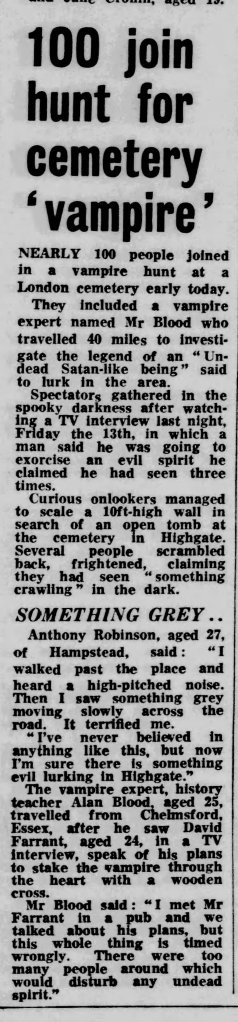
Television coverage brought the alleged vampire to an enormous audience. Manchester publicly announced his intention to conduct an exorcism at Highgate Cemetery.
What happened next was extraordinary.
As darkness fell, hundreds of people began descending upon Swain’s Lane.
They came from across London.
Some reportedly carried wooden stakes.
Others brought crucifixes.
Garlic.
Torches.
And presumably a great deal of misplaced confidence in their ability to fight the undead.
The locked cemetery gates couldn’t hold them back.
People climbed over walls and forced their way into the grounds, trampling across historic graves as they searched through the darkness for a vampire.
Police were reportedly overwhelmed by the sheer number of people.
For one extraordinary night, modern London had descended into something resembling a medieval vampire hunt.
Hundreds of ordinary people were running through an overgrown Victorian cemetery in the darkness, armed with stakes and crucifixes, genuinely hoping—or perhaps fearing—that they might encounter the undead.
And yet the story was about to become darker still.
THE STAKING CLAIMS
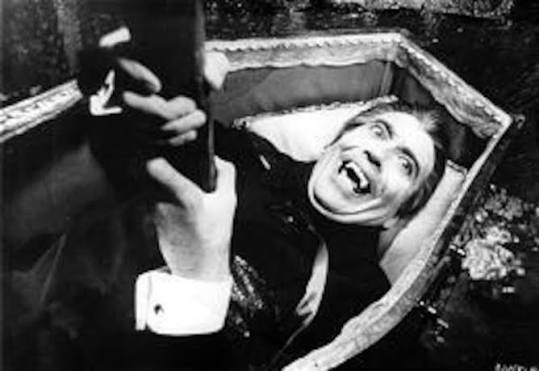
In the months and years following the great vampire hunt, the claims became increasingly dramatic.
Manchester later alleged that he and a group of companions returned to the cemetery and were guided by a young woman said to be in some kind of psychic trance.
According to his account, they entered a family vault and opened a coffin.
Inside, Manchester claimed they discovered a fresh-looking, bloated corpse with blood around its mouth.
He supposedly prepared to drive a wooden stake through the body’s heart but was persuaded not to do so.
Instead, the tomb was allegedly treated with garlic and holy water before being sealed.
There is an obvious and important distinction to make here:
This is Manchester’s account of events. It is not independently established fact.
And Manchester’s most spectacular claim was still to come.
He later stated that the vampire had escaped Highgate and relocated to an abandoned house nearby.
There, he claimed, he finally confronted the creature, drove a wooden stake through its heart and burned the remains.
According to Manchester, the Highgate Vampire had finally been destroyed.
According to everyone else?
Well… the evidence was somewhat less convincing.
THE BURNED CORPSE
Behind the theatrical claims and vampire hysteria, however, genuinely disturbing events were taking place at Highgate.
In August 1970, the badly damaged remains of a woman’s body were discovered near the catacombs.
The corpse had reportedly been removed from its grave, decapitated and burned.
This was no ghost story.
Someone had genuinely desecrated a human body.
Highgate Cemetery had become a target for vandals, grave robbers and people apparently involved in occult rituals. Whether these activities had any connection to the alleged vampire is another question entirely.
But discoveries such as this inevitably added fuel to the growing hysteria.
🪦 DAVID FARRANT AND THE LAW
David Farrant also found himself in serious legal trouble.
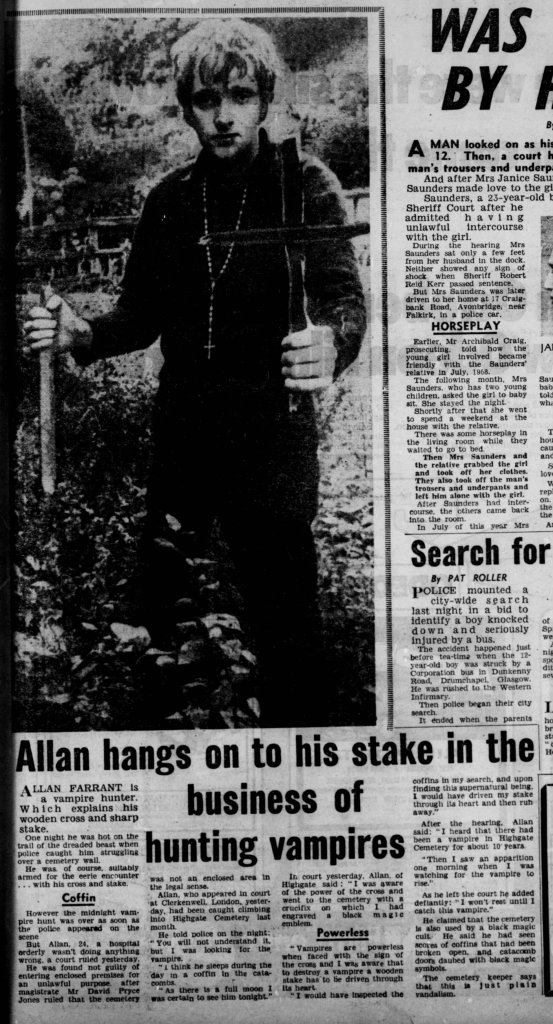
In August 1970, police discovered him in the churchyard adjoining Highgate Cemetery carrying a crucifix and a wooden stake.
Farrant maintained that he was investigating the supernatural entity associated with the area.
Several years later, in 1974, he was convicted of a number of offences connected with Highgate Cemetery and occult activity, including damaging memorials and interfering with human remains.
Farrant always denied some of the accusations against him and claimed he had been framed by others involved in occult groups. Indeed he sued the Hampstead and Highgate Express newspaper in the 1970s
He was sentenced to several years in prison.
The Highgate Vampire story had moved from newspaper letters and ghost sightings into something considerably darker and more real.
THE GREAT VAMPIRE FEUD
And then there was the feud.
David Farrant and Seán Manchester became bitter enemies.
Each questioned the other’s credibility.
Books were written.
Accusations were exchanged.
Rival organisations emerged.
And eventually, the dispute moved online, where the pair continued attacking one another’s claims and credentials.
The feud lasted for decades, finally ending only with David Farrant’s death in 2019.
In some ways, the rivalry between the two vampire hunters became almost as famous as the alleged vampire itself.
RICHARD’S VERDICT
So, did a vampire really stalk Highgate Cemetery?
I can’t honestly say that I believe a vampire existed at Highgate Cemetery, not in the supernatural bloodsucking undead kind of way (because they only exist in print and on celluloid). A supernatural vampire may not exist as a physical creature, but belief in vampires unquestionably does—and people can act upon that belief in very real ways.
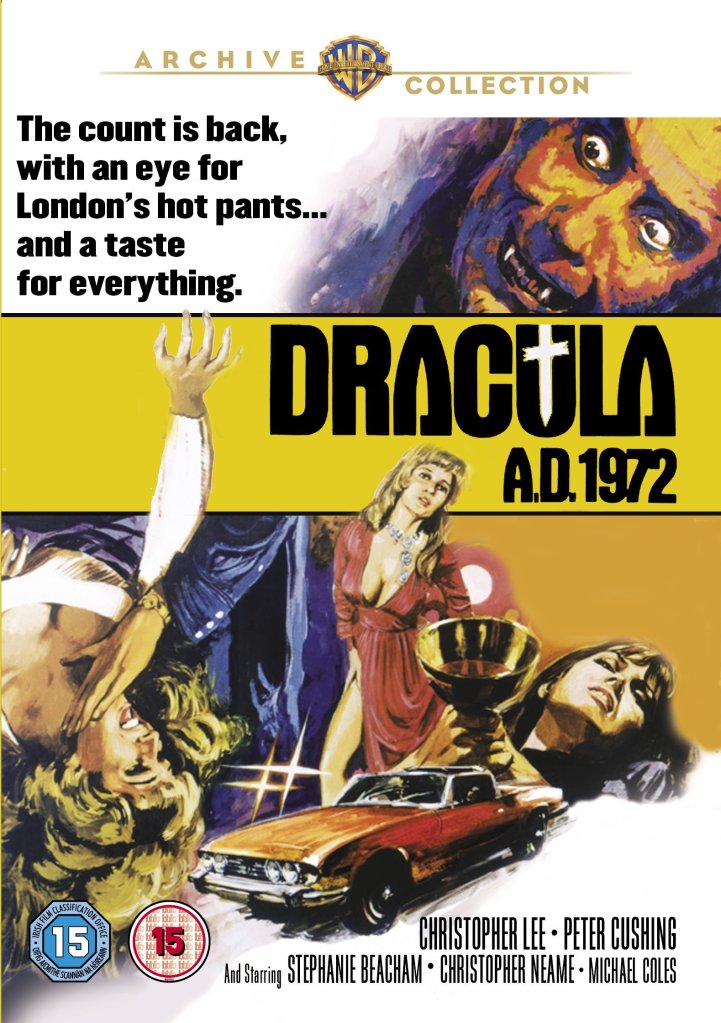
There is simply no reliable evidence that an undead Romanian aristocrat was buried beneath Highgate Cemetery, telepathically enslaved young women, drank blood and was eventually destroyed with a wooden stake by a bogus bishop. It just reads like the plot to a Hammer Horror film, which, it inspired. Dracula AD 1972 drew its inspiration from The Highgate Vampire.
Those extraordinary claims rely overwhelmingly on the testimony of individuals deeply involved in the story.
But I don’t think that makes the Highgate Vampire case any less fascinating.
Because something extraordinary did happen at Highgate.
People really did report strange figures and apparitions.
The cemetery really had become an atmospheric, overgrown Gothic wilderness.
Graves really were desecrated.
A human corpse really was removed from its resting place and horribly mutilated.
And on Friday, 13 March 1970, hundreds of people really did descend upon Highgate Cemetery searching for a vampire.
For me, the Highgate Vampire isn’t convincing evidence for the existence of the undead.
It’s something perhaps even more fascinating:
A perfect example of how folklore is born before our very eyes. And how we haven’t really moved on from our god fearing ancestors.
A handful of strange sightings.
An abandoned Victorian cemetery.
Two eccentric and fiercely competitive occultists.
Sensational newspaper headlines.
Television coverage.
Public fascination.
And suddenly, a ghost story became a vampire story—and the vampire story became a genuine social phenomenon.
In my opinion there never was a vampire at Highgate.
But for one extraordinary night in March 1970, hundreds of Londoners behaved as though there was.
And that, to me, is what makes the Highgate Vampire one of the strangest and most fascinating stories in British paranormal history.
EVIDENCE RATING: 1.5 OUT OF 5
There are genuine eyewitness reports of strange figures and unexplained experiences around Highgate Cemetery, but the more spectacular vampire claims lack convincing independent evidence.
For the existence of a literal vampire? The evidence doesn’t exist.
As an example of modern folklore, mass hysteria and the extraordinary power of belief?
It’s absolutely extraordinary.
The truth may be stranger than the stories.
Tomorrow on Paranormal 365 – The Black Monk of Pontefract.
#365DaysOfTheParanormal #Day13 #FavouriteHaunts #HighgateVampire #HighgateCemetery #BritishParanormal #Vampire #VampireHunter #DavidFarrant #SeanManchester #GhostStories #OccultHistory #LondonGhosts #UrbanLegends #ParanormalUK #UnexplainedMysteries #FridayThe13th #TheTruthMayBeStrangerThanTheStories

