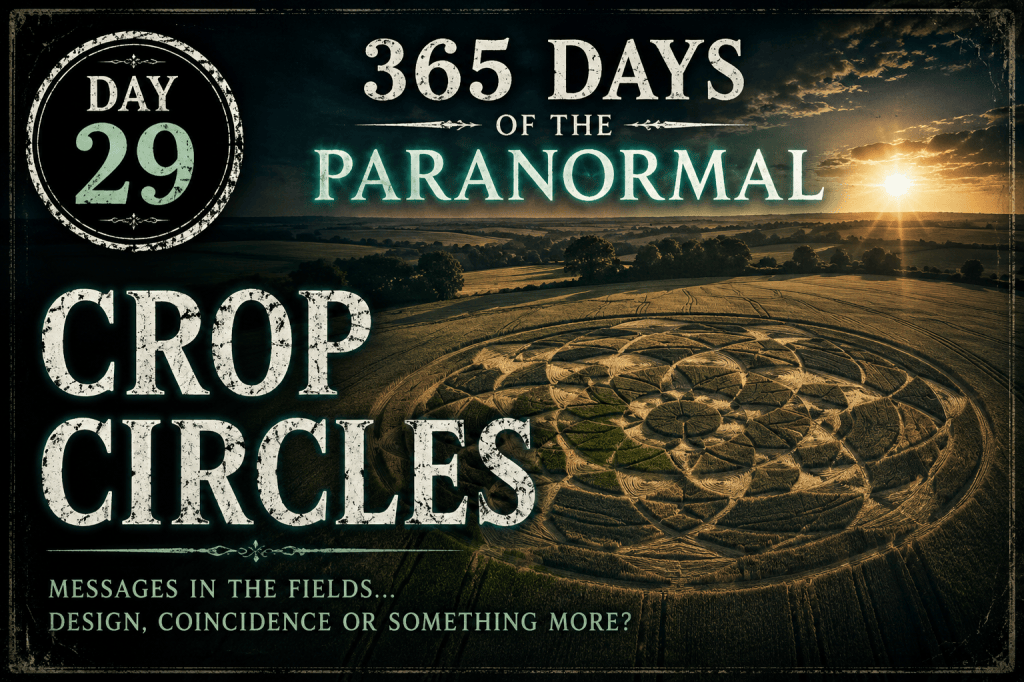
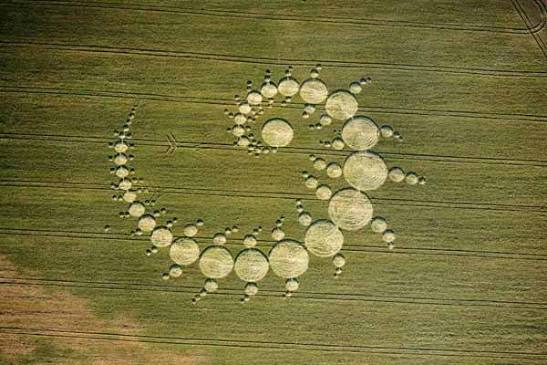
The phenomenon of crop circles—intricate, geometric patterns flattened into fields of wheat, barley, and rye—has captivated the public imagination for decades. What started as simple, localized flattened circles in the English countryside evolved into massive, breathtaking works of art that span hundreds of feet across.
Whether viewed as supernatural messages or brilliant feats of human engineering, crop circles occupy a unique space where art, folklore, science, and mystery collide.
The Origins: From Simple Rings to Complex Formations
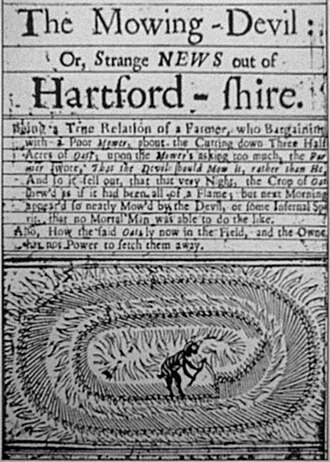
While folklore mentions mysterious circle formations as far back as the 17th century (such as the famous 1678 “Mowing-Devil” woodcut), the modern crop circle explosion began in the late 1970s and 1980s, primarily in Wiltshire, England.
- The Early Years: Early formations were basic single circles of simple rings appearing overnight in farm fields.
- The Evolution: By the 1990s, simple shapes gave way to intricate fractals, sacred geometry, complex pictograms, and mathematical formulas like the Mandelbrot set.
The Debate: How Are They Made?
The ultimate question surrounding crop circles is always the same: Who or what is making them?
| Perspective | Mechanisms and Arguments |
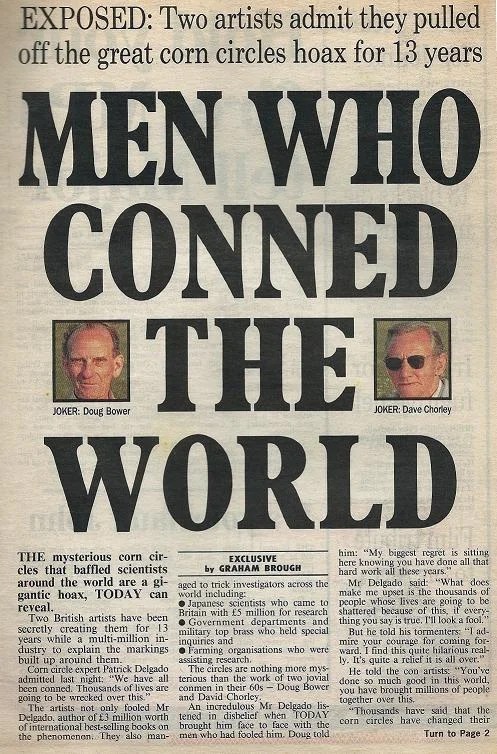
| Human Artistry | In 1991, Doug Bower and Dave Chorley came forward claiming they started the modern trend using simple boards, ropes, and night vision. Professional “circle makers” have since demonstrated the ability to create vast, complex geometric patterns overnight using land-surveying techniques and stomper boards. |
| Paranormal & UFOs | Enthusiasts point to formations created in extremely short timeframes, anomalous electromagnetic readings, bent plant nodes that show signs of heat stretching (cavitation), and complex mathematical symmetry as evidence of extraterrestrial or non-human intervention. |
| Natural Phenomena | Early scientific theories suggested plasma vortices, ball lightning, or localized whirlwinds, though these theories struggled to explain intricate, highly structured geometric designs. |
Doug Bower and Dave Chorley: The Original Circle Makers
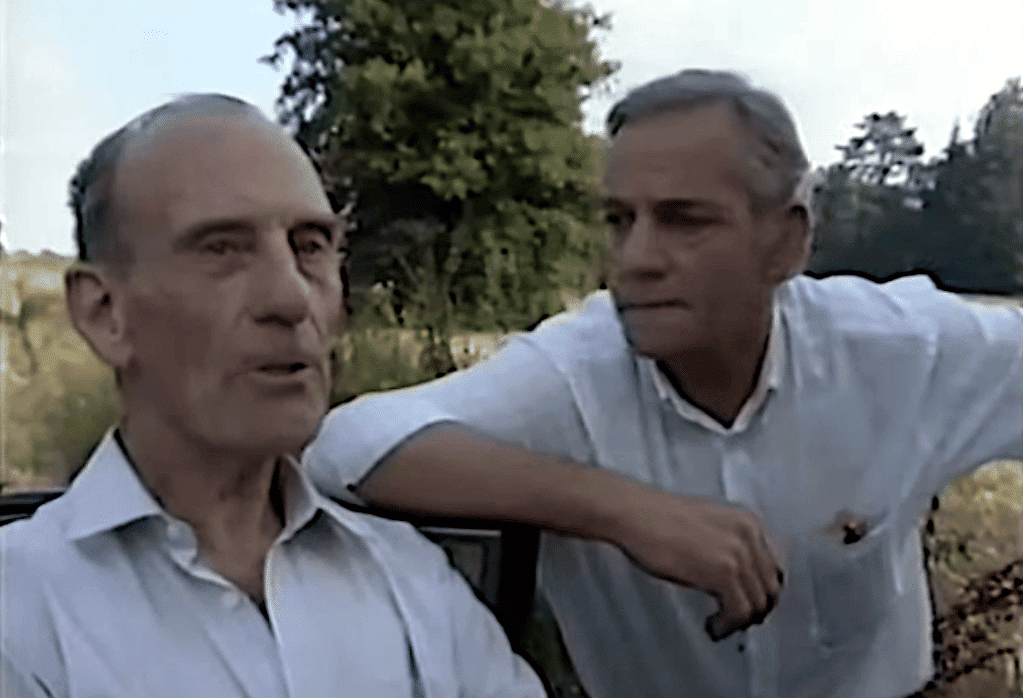
In September 1991, two English amateur pranksters in their 60s, Doug Bower and Dave Chorley, held a press conference in a field in Warminster, England. They announced that they claimed responsibility for creating many of the modern crop circles that appeared across southern England during the late 1970s and 1980s, which consumed the media and UFO enthusiasts during this time.
- The Inspiration: Bower had lived in Australia during the 1960s and remembered hearing stories of the “Tully Saucer Nests”—circular areas of flattened reeds attributed to localized weather phenomena or UFO landings.
- The First Attempt: Around 1976 or 1978, over drinks at a pub, Bower suggested to Chorley that they create a fake landing site in the Hampshire/Wiltshire countryside to see if anyone would believe a flying saucer had landed.
- The Escalation: Using a heavy iron security bar originally, they knocked down wheat to form simple circles. For years, their creations went mostly unnoticed, driving them to place designs near visible viewpoints. Once the press picked up on the story and “experts” began claiming the circles were formed by alien spacecraft or atmospheric plasma vortices, Bower and Chorley deliberately escalated the complexity. They created complex geometric rings, pathways, and pictograms to directly mock the natural/paranormal theories.
How Human Artists Flatten Fields overnight
Following Bower and Chorley’s revelation,which they proved live on camera in front of journalists,a whole community of landscape artists known as “circle-makers” emerged. The tools and techniques required to create massive, intricate patterns in total darkness are surprisingly mechanical and relies on basic geometry.
The Essential Toolkit
- Stomper Boards (Planks): Wooden planks (often 4 to 5 feet long) fitted with ropes attached to both ends. A maker steps on the plank with one foot while holding the ropes to drag and press down the stalks smoothly.
- Surveyor’s Tape & Ropes: Key for drawing concentric circles, radiuses, and straight geometric construction lines.
- Sighting Tools: Simple wire-loop sights attached to baseball cap brims (used by Bower and Chorley) or laser pointers aimed at landmarks to maintain straight lines across hundreds of feet in the dark.
The Process: From Paper Blueprint to Canvas
Pre-Planning: Artists sketch complex Euclidean geometries, mathematical fractals, or spiraling patterns onto grid paper beforehand, converting measurements into physical step counts or rope lengths.
- Undetected Access: Teams walk strictly along existing farmer tractor paths (tramlines) to reach the centre of the field without leaving footprint tracks in standing wheat.
- Layout & Anchoring: A central pin or team member acts as an anchor point. Using non-stretch rope stretched taut to a specific radial measurement, a maker sweeps out a circle around the centre point, creating a precise perimeter outline.
- Flattening: Starting from the centre or edge, makers push down the grain using their stomper boards in a continuous sweeping direction. By alternating clockwise and counter-clockwise passes across adjacent shapes, they create stunning multi-directional lighting effects when viewed from above.
Modern arts collectives, such as the UK-based Circlemakers, have since pushed this human technique to an elite level, executing complex mathematical designs with thousands of individual geometric elements in just a few hours under the cover of night.
Not Restricted to the UK
While southern England remains the epicentre of the phenomenon, particularly Wiltshire and Hampshire, with more formations reported there than anywhere else. Crop circles have been documented in over 50 countries worldwide.
- North America (United States & Canada): Hundreds of crop circles have appeared across states like Ohio, California, and South Dakota, as well as Canadian provinces like Alberta and Manitoba. North America has a rich history of simple circular formations dating back to the 1960s and 1970s, often dubbed “saucer nests” by local media before complex geometric designs became popular.
- Continental Europe: Countries such as Germany, France, Switzerland, the Netherlands, and Italy regularly see formations during the summer harvest seasons. European designs frequently match the geometric complexity of those found in Wiltshire, created by local artists and collectives using similar land-surveying techniques.
- Australia: Australia holds some of the earliest publicized accounts of circular swamp-reed and field flattening. The famous 1966 “Tully Saucer Nests” in Queensland played a direct role in inspiring Doug Bower and Dave Chorley to start making crop circles in the UK.
- Latin America & Asia: Formations have been documented in wheat, canola, and rice fields across countries like Brazil, Argentina, Russia, and Japan. In Japan, circular patterns in rice paddies led to the development of Tambo Art (Rice Paddy Art)—a deliberate, highly structured agricultural tradition where farmers plant different colored strains of rice to create massive visual murals.
Why Are They Found in Specific Places?
Researchers and sceptics note that international crop circles follow clear patterns:
- Suitable Crops: They almost exclusively appear in flat, easily flattened cereal crops like wheat, barley, rye, and canola.
- Access & Visibility: Formations heavily cluster near roads, accessible fields, and populated areas where creators can easily enter and where aerial photographers or drone pilots can spot them.
- Cultural Spreads: The explosion of overseas crop circles occurred primarily after the late 1980s and early 1990s, when international news outlets covered the British phenomenon, inspiring artists and pranksters globally to replicate the trend.
Geometry and Intricacy
Sacred geometry and advanced mathematical concepts transformed crop circles from simple agricultural pranks into complex field art. Grounded in geometry, topology, and mathematics, these designs rely on precise structural principles.
Sacred Geometry: Sacred Proportions & Harmonious Shapes
Sacred geometry attributes symbolic and spiritual meanings to specific geometric shapes and proportions. Crop circles frequently incorporate these fundamental forms:
- The Vesica Piscis: Formed by intersecting two circles of equal radius so that the centre of each lies on the circumference of the other. It acts as the foundational geometric template for creating equilateral triangles, hexagons, and golden ratio proportions.
- Flower of Life: A overlapping-circle grid that creates hexagonal flower-like patterns. This design requires strict radial symmetry across thousands of field steps to avoid visual distortion from the ground.
- Metatron’s Cube & Platonic Solids: Formations often embed 3D projections of the five Platonic solids (cube, tetrahedron, octahedron, icosahedron, dodecahedron) onto a 2D plane using interlocking triangles and circles.
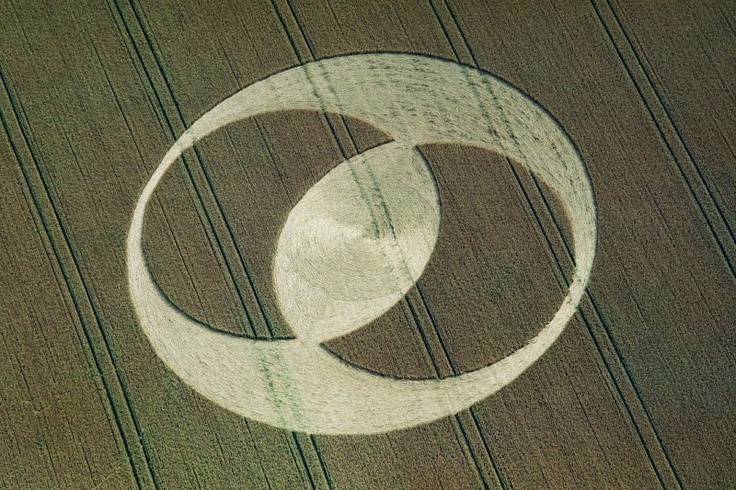
Vesica Piscis Crop Circle
Mathematical Principles & Famous Formations
Circle-makers transition from simple shapes to complex constructs using Euclidean geometry and numerical constants.
| Formation and Location | Mathematical Principle | How it was Encoded |
| Stonehenge “Julia Set” (1996) | Fractal Geometry & Complex Numbers | A classic fractal pattern created by plotting complex functions. The formation spanned 915 feet and consisted of 151 smaller circles arranged along a logarithmic spiral, scaling continuously downward. It is often referred to as the “Stonehenge Julia Set” because it appeared opposite Stonehenge near Winterbourne Stoke. |
| Barbury Castle “Pi” (2008) | Euclidean Angular Grid & Irrational Numbers | The formation appeared to encode the first ten digits of π using alternating arc lengths around the circle. The 150-foot pattern divided a circle into 10 equal 36^∘ radial segments. Starting from the centre, spiralling arcs stepped outward across sectors equal to each digit, complete with a tiny circular dot for the decimal point. |
| Milk Hill “Double Triskelion” (2001) | High-Order Radial Symmetry & Topology | Composed of 409 individual circles spanning 780 feet across uneven terrain. It relied on a 6-fold symmetry layout with three interlocking logarithmic spirals. It appeared overnight in August 2001 and remains one of the largest genuine crop circle formations ever recorded in Britain. |
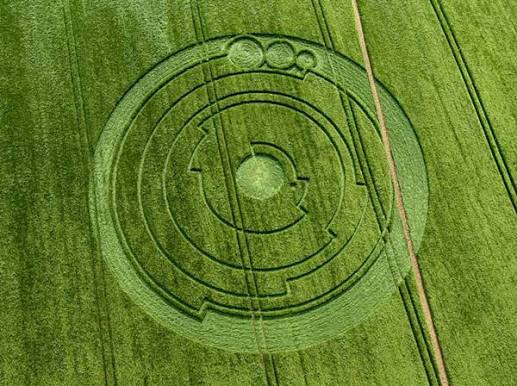
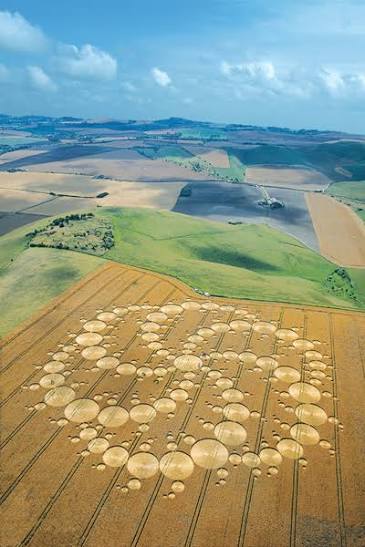
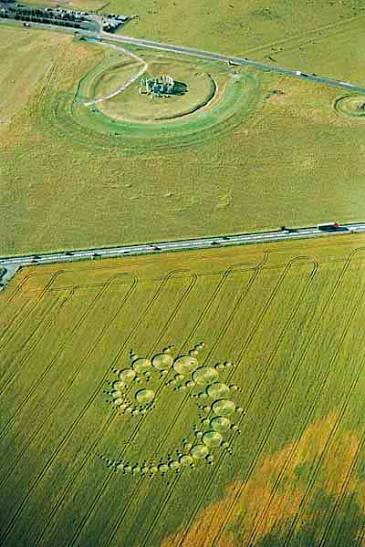
From the top left: Milk Hill Double Triskelion, Barbury Castle “Pi” and Stone Henge “Julia Set”
Paranormal Claims
Supporters of paranormal explanations point to several recurring reports associated with crop circles:
Witnesses have claimed to see glowing orbs of light hovering over fields shortly before formations appeared.
Some crop circles are said to have appeared within just a few hours, leaving investigators questioning how such complex designs could be completed unnoticed.
Researchers have reported unusual electromagnetic readings and occasional interference with cameras, compasses, and other electronic equipment within certain formations.
A number of investigators have suggested that some plants found within crop circles show unusual bending patterns or microscopic changes, although these findings remain highly debated within the scientific community.
Others believe crop circles may represent messages from extraterrestrial intelligences, interdimensional beings, or unknown natural forces that humanity has yet to understand.

Despite decades of investigation, no paranormal explanation has been conclusively proven. Yet neither has the fascination disappeared. Every summer, new formations appear, new theories emerge, and the debate begins all over again.
The Cultural Impact
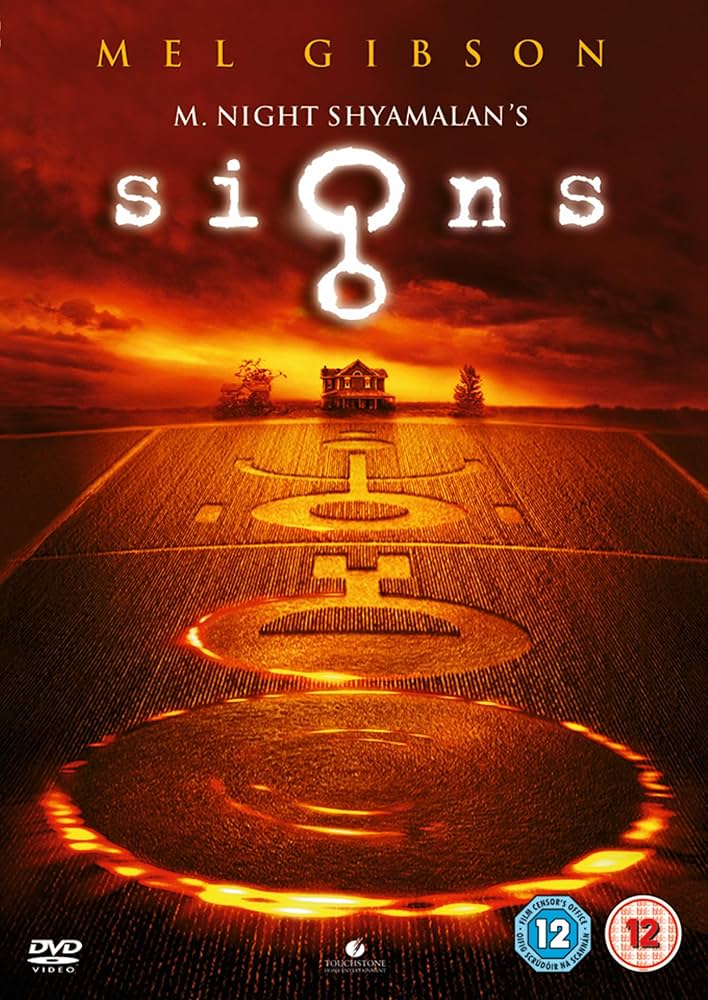
Crop circles have left an indelible mark on popular culture. They featured heavily in science fiction classics like the 2002 film Signs, inspired landscape art movements, and created a boom in local tourism across Southern England. To this day, “croppies” (crop circle researchers and enthusiasts) gather every summer in hopes of discovering the season’s newest, most complex formation.
Regardless of their origin, crop circles remain a fascinating testament to human curiosity, artistic expression, and our timeless desire to look out at a field and wonder about the unknown.
Richard’s Verdict
Crop circles are one of the few paranormal mysteries where I think the truth is probably a mixture of human creativity and an energy which we as humans have yet to understand. There is little doubt that talented circle makers can create astonishing formations that would leave most of us scratching our heads. However, some reports surrounding crop circles remain difficult to explain entirely, particularly the eyewitness accounts of strange lights and the speed with which some formations are said to appear.
Do I believe crop circles are messages from extraterrestrials? It’s possible but not probable. Although less prolific in appearance than they used to be in the 1970’s and 1980’s, I don’t think we have heard the last from this phenomenon.
Whatever their true origin, crop circles remain one of the most fascinating intersections of art, mystery, and the unexplained.
The truth may be stranger than the stories.
#365DaysOfTheParanormal #CropCircles #FavouriteHaunts #Paranormal #UnexplainedMysteries #UFOs #AncientMysteries #HighStrangeness #Mystery #Wiltshire #CropCircleMystery #AlienEncounters #Fortean #WeirdBritain #TheTruthMayBeStrangerThanTheStories


Leave a Reply