Black Shuck, The Hell Hound of East Anglia
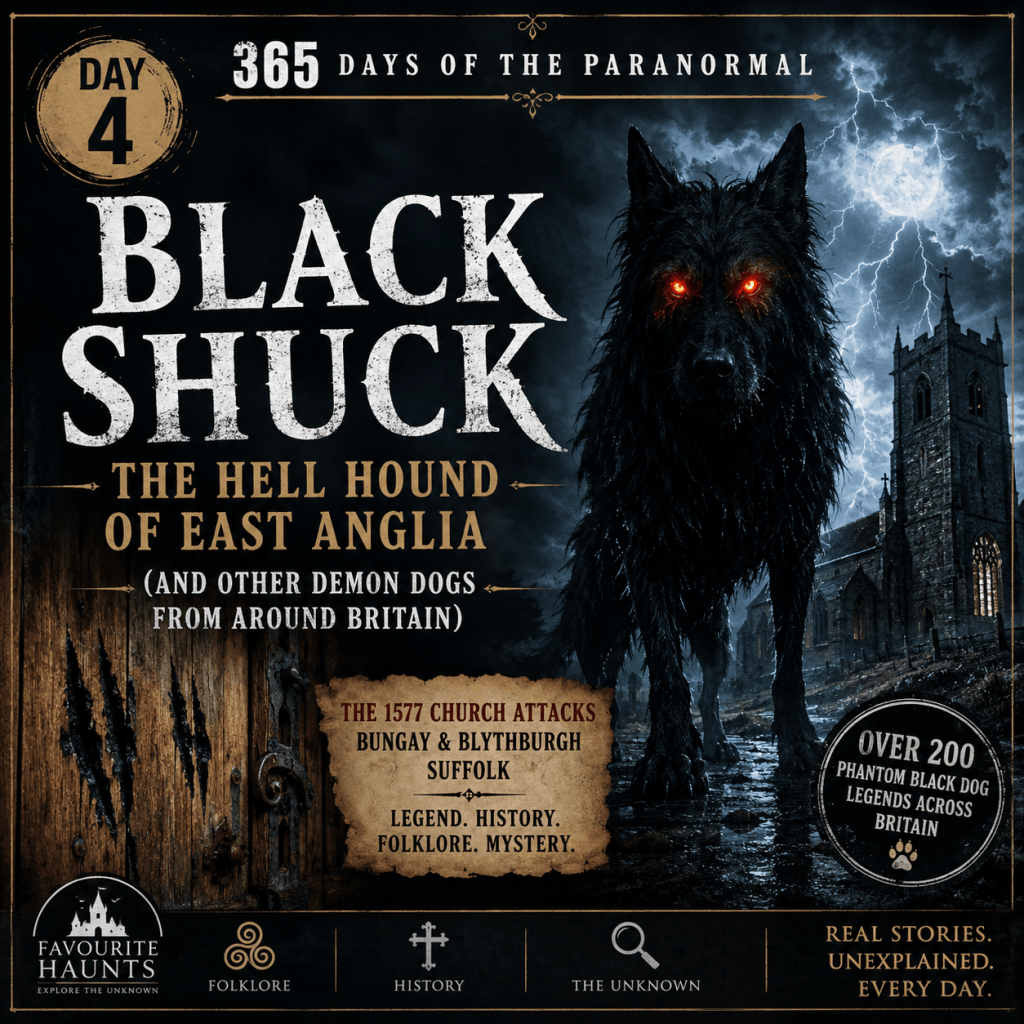
Good afternoon! Grab a coffee, because today’s story is one of the oldest, most atmospheric, and genuinely chilling pieces of folklore in the British Isles.
I first discovered the legend of Black Shuck in an old copy of *The Hamlyn Book of Ghosts*, which seemed to spend more time on loan from my local library in Belmont than it did on its shelves! Like many paranormal enthusiasts, I devoured every page. Then, around twenty years later, I met my wife, who grew up in Norfolk (where her parents still live today), and my fascination with the legend was reignited.
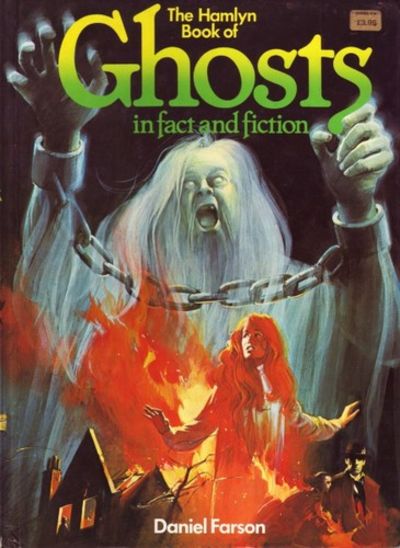
The Hamlyn Book of Ghosts, which I still have on my bookshelf
For well over a thousand years, lonely coastlines, dark country lanes, ancient churchyards and windswept commons across East Anglia—particularly Norfolk and Suffolk, but also parts of Essex and Cambridgeshire—have been haunted by tales of a monstrous spectral black dog known simply as **Black Shuck**.
—
The Appearance and the Name
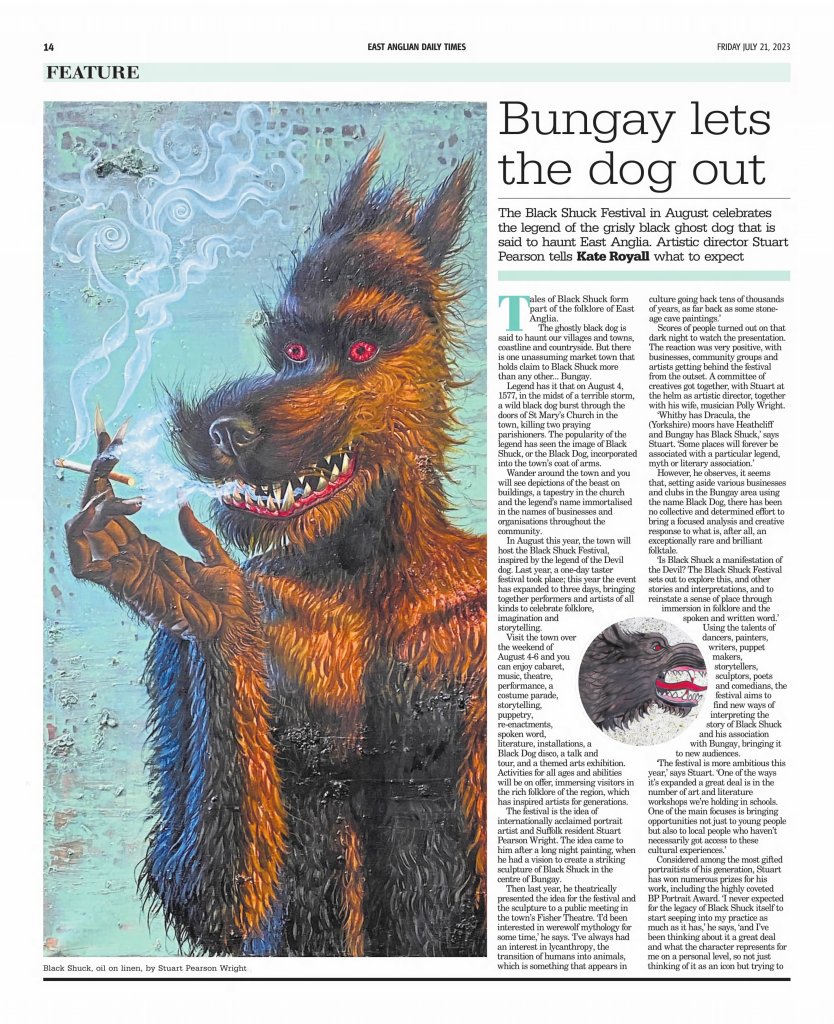
The name “Shuck” is generally believed to derive from the Old English words scucca or sceocca, meaning “demon” or “devil.” Some local dialects also connect the name with the word “shucky,” meaning shaggy or hairy, perfectly fitting the creature’s fearsome appearance.
Witnesses have described Black Shuck not simply as a large dog, but as an impossibly huge beast, sometimes said to be the size of a calf or even a small horse.
Descriptions commonly include:
• Shaggy, jet-black fur.
• Eyes glowing like burning coals—or, in more modern retellings, bright bicycle lamps.
• An unnaturally silent gait, often making no sound whatsoever as it approaches.
• In some versions of the legend, Shuck possesses a single enormous glowing eye set in the middle of its forehead, while other accounts describe two blazing red eyes.
Perhaps most unsettling of all is what Black Shuck represents.
To encounter him is traditionally regarded as an omen of death. According to local folklore, anyone who meets his gaze may die—or lose someone close to them—within the following year.
—
The Storm of 4 August 1577
Although stories of Black Shuck almost certainly pre-date written history, the legend became forever linked with one terrifying summer storm during the reign of Queen Elizabeth I.
The Attack at Bungay
On 4 August 1577, an exceptionally violent thunderstorm swept across Suffolk.
As the congregation gathered inside St Mary’s Church in Bungay, lightning crashed overhead and thunder shook the building.
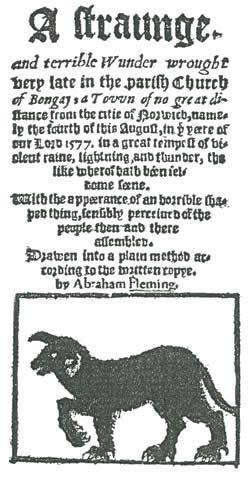
According to a pamphlet published later that year by the clergyman Abraham Fleming, entitled “A Straunge and Terrible Wunder”, a gigantic black dog burst into the church.
The creature was said to have run through the congregation, killing two parishioners and seriously injuring another before disappearing as suddenly as it had arrived.
Local tradition still points to blackened marks on the church doors as the Devil’s claw marks, although there is no evidence they were actually made by a supernatural creature.
—
The Attack at Blythburgh
During the same storm, approximately twelve miles away at Holy Trinity Church in Blythburgh, another terrifying event was reported.
According to local tradition, the same spectral dog entered the church, killing a man and a young boy before vanishing.
The storm itself caused extensive damage to the church, including lightning strikes that may explain many of the dramatic stories which later became attached to Black Shuck.
Even today, visitors are shown dark scorch marks on the church doors, traditionally known as “The Devil’s Fingerprints.”
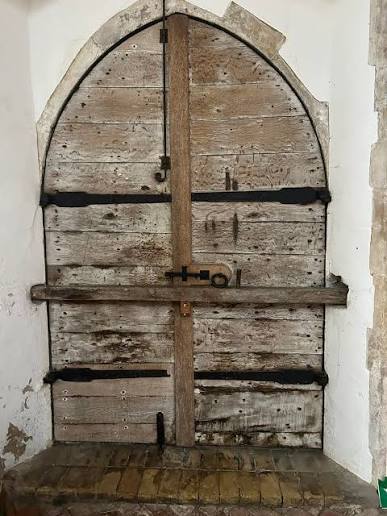
The Devils Fingerprints clearly visible on the door at Blythburgh Church

Whether these marks genuinely date from the storm—or simply became woven into the legend over time—remains unknown.
—
Where Did Black Shuck Come From?
Like many ancient legends, Black Shuck probably didn’t appear overnight.
Instead, the story appears to be a blend of several different traditions.
Norse Influence
Following the Viking settlement of eastern England during the Danelaw, Norse mythology became deeply embedded within local folklore.
The Vikings told stories of Garmr, the monstrous hound guarding the gates of Hel, while Odin’s terrifying “Wild Hunt” was often accompanied by ghostly hounds racing across storm-filled skies.
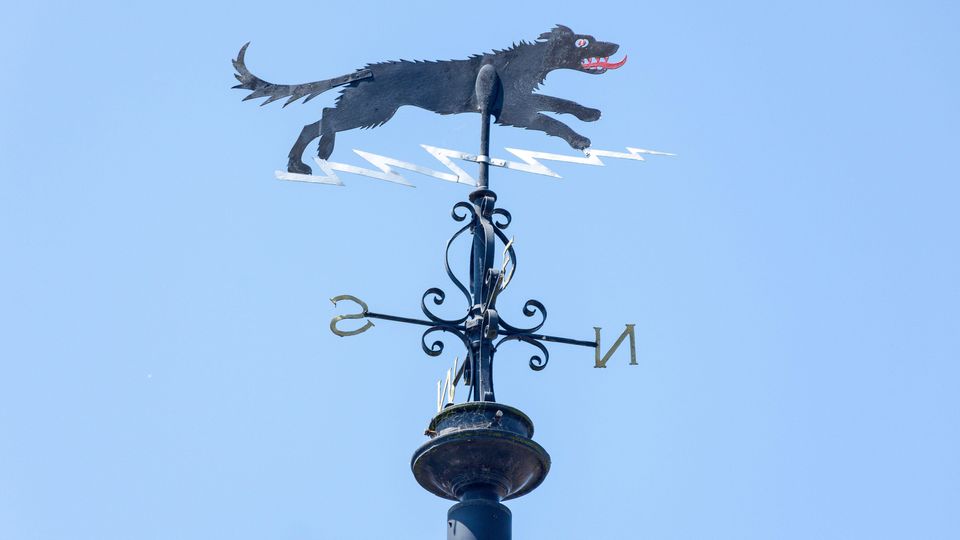
Weather Vane in East Anglia
Dogs themselves held an important place in Viking culture, with large hunting dogs sometimes buried alongside their owners, reinforcing their connection with death and the afterlife.
Celtic Beliefs
Long before the Vikings arrived, Celtic mythology already featured supernatural dogs that acted as guardians between our world and the next.
Rather than being evil, these spectral hounds often served as guides, escorting souls safely into the Otherworld.
The Landscape
Before modern roads and streetlights, East Anglia was a very different place.
Vast marshes, dense woodland, lonely heathland and isolated farm tracks created an eerie landscape where travellers often found themselves completely alone.
It’s easy to imagine how an unexpectedly large black dog emerging from thick mist—or simply the reflection of lantern light in an animal’s eyes—could become the foundation of an enduring legend.
—
Britain’s Other Phantom Dogs
Black Shuck may be the most famous, but he is far from alone.
Britain is home to more than **200 recorded black dog legends**, making them one of the country’s most widespread supernatural traditions.
The Barghest and Gytrash (Yorkshire)
Yorkshire’s infamous Barghest is perhaps Black Shuck’s closest relative.
Unlike Shuck, the Barghest is often described as a shape-shifter, capable of appearing as a giant black dog, a headless man or even a ghostly white cat.
Closely related is the Gytrash, another spectral black dog said to haunt lonely roads and ancient trackways.
Many northern legends describe these creatures as harbingers of death, often accompanied by the eerie sound of dragging chains or unseen footsteps behind travellers.
—
Padfoot (Northern England)
The Padfoot takes its name from the rhythmic padding sound said to follow lonely walkers along deserted roads.
Many witnesses claimed they could hear heavy footsteps close behind them…
…yet whenever they turned around, nothing was there.
—
The Wisht or Yeth Hounds (Devon)
Across Dartmoor, the legend changes dramatically.
Instead of one enormous dog, local folklore speaks of an entire pack of ghostly black hounds racing across the moors during violent storms.
Sometimes called the Wisht Hounds or Yeth Hounds, they are said to be led by either the Devil or the ghost of a wicked huntsman.
The word Wisht is generally understood to mean ghostly or uncanny.
Many historians believe these Devon legends helped inspire Sir Arthur Conan Doyle while writing *The Hound of the Baskervilles*, alongside stories of Black Shuck from East Anglia.
—
The Moddey Dhoo (Isle of Man)
One of Britain’s best-known ghost dogs haunted Peel Castle.
Known as the Moddey Dhoo (“Black Dog”), it was reportedly seen by generations of soldiers silently entering the guardroom each evening before disappearing into the darkness.
Legend tells of one drunken soldier who finally challenged the creature.
He returned pale, speechless and terrified…
…and died just three days later.
—
The Gwyllgi (Wales)
In Wales, the terrifying Gwyllgi, meaning “Dog of Darkness,” prowls lonely crossroads and mountain paths.
Descriptions portray it as a huge coal-black mastiff with fiery breath and glowing red eyes.
Like Black Shuck, simply seeing it was often considered a warning that death was near.
—
The Church Grim
Not every ghostly dog was feared.
According to medieval tradition, some churches were protected by a supernatural guardian known as the Church Grim.
Legend claimed that when a new churchyard was consecrated, builders sometimes buried a black dog beneath the foundations so that its spirit—not the first person buried there—would become the eternal guardian of the church.
Unlike Black Shuck, the Church Grim was believed to protect both the church and the souls resting within it.
—
How the Legend Changed
Historians generally see the evolution of Britain’s phantom dogs in three stages.
Pagan Guardians
The earliest traditions suggest these supernatural dogs were protectors rather than monsters.
Across Celtic and Romano-British Britain, dogs frequently symbolised guardianship, healing and the journey into the afterlife.
—
Christian Hellhounds
As Christianity spread, many older pagan beliefs were reinterpreted.
The protective spirit dogs gradually became associated with demons, devils and hell itself.
One of the earliest written descriptions of spectral black hunting dogs appears in the Anglo-Saxon Chronicle in 1127, when monks described a terrifying Wild Hunt seen near Peterborough.
By the sixteenth century, these supernatural hounds had become closely associated with Satan and divine punishment.
—
Smugglers and Superstition
During the eighteenth and nineteenth centuries, phantom dog stories gained a practical purpose.
Smugglers transporting tea, brandy and other contraband along isolated country lanes often encouraged local ghost stories.
If villagers believed a demon dog haunted a particular road, they stayed safely indoors—leaving the smugglers free to move unnoticed under cover of darkness.
—
A Modern Discovery
In 2014, archaeologists excavating Leiston Abbey in Suffolk uncovered the skeleton of an unusually large medieval dog.
Some newspapers quickly linked the discovery to Black Shuck.
In reality, there is no evidence that the remains belonged to the legendary hellhound.
However, the find does demonstrate that exceptionally large dogs once lived in East Anglia, providing a perfectly plausible real-world inspiration for stories passed down through countless generations.
—
Not Every Black Dog Was Evil
One of the most fascinating aspects of Britain’s phantom dog folklore is that not every black dog was considered dangerous.
In parts of Somerset, stories tell of the Gurt Dog, a huge spectral hound that silently accompanied lone travellers home at night, protecting them from robbers or darker supernatural forces before disappearing once they reached safety.
Rather than an omen of death, it became a guardian.
—
Evidence Rating
 ☆☆☆ (2/5)
Black Shuck is supported by centuries of folklore, regional traditions and one important contemporary pamphlet published in 1577.
However, there is no verifiable evidence that a supernatural black dog ever existed.
Most historians believe the stories are rooted in a mixture of unusually large dogs, severe storms, ancient religious beliefs and centuries of oral storytelling.
—
Richard’s Verdict
I think Black Shuck is one of the finest examples of how folklore evolves over time.
The stories are deeply rooted in history, and the events at Bungay and Blythburgh undoubtedly happened during a violent thunderstorm. Whether a supernatural creature was really involved is another matter.
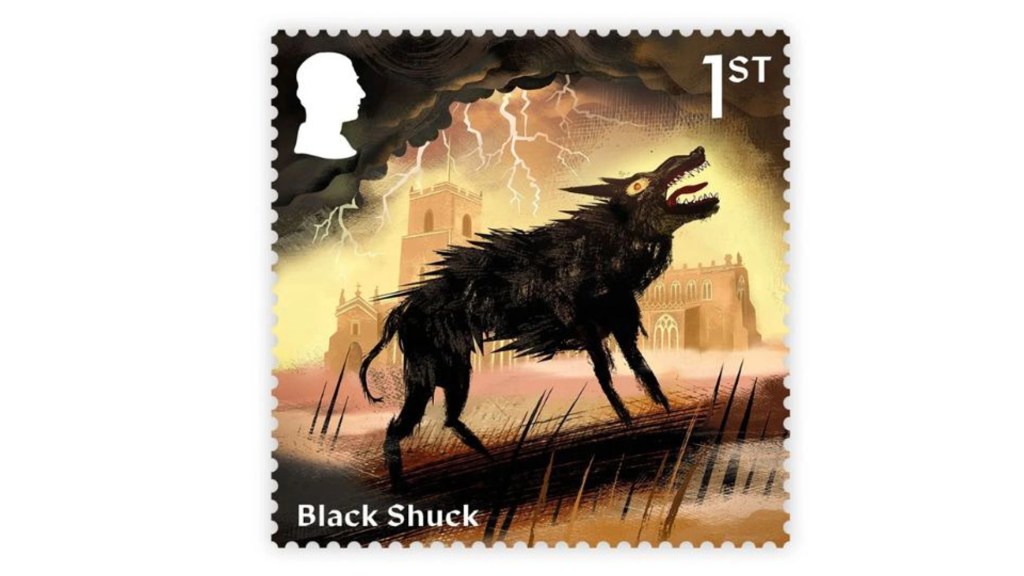
Personally, I think it’s far more likely that Black Shuck represents a blend of real events, ancient pagan beliefs and centuries of embellishment than an actual hellhound roaming the East Anglian countryside.
That said, what fascinates me isn’t whether Black Shuck existed—it’s why remarkably similar phantom black dog legends appear in well over 200 locations across Britain. There may be perfectly rational explanations, but the sheer consistency of these stories makes them impossible to ignore.
My verdict: A fascinating piece of British folklore inspired by real events, but with no convincing evidence that Black Shuck itself was ever a supernatural creature.
—
But… What Do You Think?
Could Black Shuck simply be folklore, shaped over centuries by fear, superstition and the dangers of travelling alone at night?
Or are Britain’s countless reports of phantom black dogs hinting at something we still don’t fully understand?
With more than **200 recorded black dog legends** scattered across Britain, perhaps these tales survive because they contain a grain of truth…
…or perhaps they simply remind us how powerful a good story can be.
Either way, if you ever find yourself walking alone along a lonely country lane on a stormy night…
…and hear heavy footsteps padding quietly behind you…
…you might think twice before looking over your shoulder.
—
**Did You Know?**
Britain has more recorded phantom black dog legends than almost any other type of ghostly creature, with well over **200 separate traditions** documented by folklorists.
—
365 Days of the Paranormal – Day 4
Tomorrow we head in an entirely different direction and north of the border as we encounter The Grey Man of Ben MacDui.
#365DaysOfTheParanormal#BlackShuck#HellHound#BritishFolklore#GhostStories#Paranormal#EastAnglia#Folklore#Cryptids#Legends#Mystery#History#Supernatural#GhostDogs#Barghest#Gwyllgi#ChurchGrim#FavouriteHaunts


Leave a Reply